Our June safari ended with a bang — at Victoria Falls in Zimbabwe.
To get there, we hopped on a small plane to northern Botswana, then crossed the border by cab. Right away, the contrast between the two countries was striking. In Botswana, everything just worked — smooth roads, friendly faces, a general sense of ease. Zimbabwe told a different story. The cab ride was bumpy, the seatbelts barely functioned, and there was no AC. More than that, the economic struggles were impossible to miss. Everywhere we went, people asked for tips or tried to sell us trinkets.
We checked into the famous Victoria Falls Hotel, built in 1904. Though updated over the years, it still radiates British colonial vibes — you can practically feel the “upstairs—downstairs” dynamic. Maybe that explains why every service, no matter how small, seemed to come with an unspoken request for a tip.
In 1904Today
The hotel may have been a mixed bag, but the Falls? Absolutely jaw—dropping. It’s easy to see why they’re considered one of the seven natural wonders of the world: 1,700 meters wide, 108 meters high, and roaring with power.
We followed the nature trail with its 17 viewpoints, each one revealing a new angle of the thundering cascade. Water exploded from the cliffs, sending a mist so heavy it soaked us through — no need for rain showers here!
We passed the statue of David Livingstone, who brought news of the Falls to Europe in 1855 (though, of course, local communities had known of them long before).
We’d visited the Falls before, in November 2012, and barely got wet that time. So when locals offered rain slickers this June, we smugly declined. Big mistake. June means far more water, and we were drenched. Thankfully, the hot African sun dried us out quickly.
That Was Then, This Is Now
Some things had definitely changed since our 2012 trip. The airport is far more modern now.
In 2012Today
But other parts felt like stepping right back into the past.
Zambezi River Cruise → Still the same peaceful ride, spotting animals lounging along the riverbanks
Jan in 2012Jan in 2025
Bridge to Zambia → Still buzzing with life, still filled with trucks inching through customs, and still home to bungee jumpers hurling themselves off the edge (not us, then or now!).
Jan on bridgeNote: Not us!
The Big Tree → This baobab tree is still massive, still magical, still wrapped in folklore.
Farewell for Now
And just like that, our African adventure came to a close. Victoria Falls gave us a finale that was equal parts humbling, exhilarating, and unforgettable.
“Up close and personal” barely captures our experience with the lions near Mokete camp in Botswana.
As apex predators, lions hunt not just with strength but with brainpower. We found ourselves marveling—not just at their roar—but at their strategic planning and execution.
Buffalo at Sundown
On our first outing to track the lions, we encountered this gigantic herd of over 2000 Cape Buffalo.
The buffalo were relaxed, enjoying the companionship of the cattle egrets and yellow oxpeckers who were removing ticks, fleas, and other parasites from their hides.
As we watched, two lionesses tracked this massive herd of buffalo as the sun eased into dusk.
They scouted, searching for a weak link. One lioness climbed a termite mound and roared—a call for reinforcements, a step in the plan.
The herd stayed tight. No help arrived. The lionesses withdrew—hungry, but undeterred.
Breakfast, the Next Morning
At dawn, reinforcements had arrived. This time the odds shifted.
The lions slipped through the grass, coordinated their approach, and closed in from multiple angles.
They separated the lone buffalo.
And then they attacked from multiple directions.
We learned that lions don’t break necks. They suffocate. A bite to the throat collapses the windpipe, or they clamp the muzzle shut. Once the prey fell, the pride regrouped and fed in turn, each waiting its moment. Watching them, we couldn’t help but notice the quiet efficiency of it all—like an old rhythm practiced many times before.
Strategy in the Grass
What struck us most wasn’t the violence—it was the calm calculation.
Every pride member seemed to know their role. One distracted, another flanked, a third watched the herd’s cohesion. They probed, tested, adjusted.
Evolution shaped the behavior, our guide explained, and it felt deliberate—a type of significant intelligence and problem-solving. We noted how some groups of people might benefit from that kind of instinctive and disciplined teamwork.
Teaching and Echoes
Another day, a different pride brought down a buffalo and turned the carcass into a classroom.
Two-month-old cubs were pushed forward to learn the basics of meat, teeth, and survival. They learned to taste blood by licking their mother’s face. Training in its rawest form.
This carcass was a tasty meal for the entire pride, and they took turns dining well into the night.
The hyenas waited patiently nearby for their turn at the action.
By morning, all remnants of the carcass were gone, except for some spots of blood.
Elsewhere, two lions alternated between guarding and feeding on a young elephant carcass.
Later, a pair of males roared across the river to their brothers in Namibia. The response came back in stereophonic thunder, shaking us to our cores.
Surrounded
One of the most unforgettable moments came when our safari jeep suddenly found itself surrounded by lions.
More and more lions popped up out of the grass and sauntered by our jeep. The effect swallowed us—so powerful it felt like an initiation into their clan. When they roared, the volume shook the air, yet we never felt unsafe. Instead, it was as if we’d been briefly folded into their circle.
Small Camps, Big Lessons
Our guides weren’t just drivers. They were storytellers, ecologists, teachers. They wanted us to see not just the hunt, but the system behind it: the planning, the discipline, the way each action fed into the balance of the ecosystem.
Unlike other safari regions, this one remains refreshingly uncluttered. Camps are small and remote. A few vehicles, never a traffic jam. Each sighting feels private, raw, and real.
The lions are habituated to safari vehicles. Our guides said they don’t mind our vehicles close by – the lions just assume we’re a different, non-threatening species. Some lions even like to sit in the shade supplied by the vehicle. You can see how close we are!
To sit within a pride of lions, hear them roar across borders, and watch them teach their cubs the rules of survival—this is to glimpse the circle of life as it truly unfolds.
As the sun set each evening, we returned to the comfort and safety of camp. The smell of wood smoke drifted in the air, lantern light flickered on canvas walls, and the images of the day lingered—later mixing into our dreams, but only after we had sipped our fine South African wines.
The Okavango Delta in Botswana boasts an incredible diversity of wildlife. During our two-week safari in June, we marveled at this ecosystem, with its lush waterways, vast collections of animals, active birdlife, and luxurious ‘glamping’.
The Okavango Delta is one of the largest intact inland delta systems on Earth. It’s fed by the Okavango River, which flows over a thousand kilometers from its source in Angola. Our safari camp, Jacana, is only accessible by boat during the winter, so our guides used several types of water transportation to expertly navigate the area.
We were joined in this adventure by our two friends, Todd and Barbara.
Living Their Best Life
With Botswana’s strong conservation laws and such abundant water supply the animals were thriving. We wondered – “if we were reincarnated and landed here, which animal would we be?” Our first thought was to be a hippo, as they tend to lounge around in groups and savor the sunlight. They even have little friends, yellow-billed oxpeckers, to pick bugs off their back. Nice!
But, we learned that hippos like to live in their own poop, so we nixed this idea.
Our next idea was to return as a Saddle-billed Stork, since they are beautiful and surrounded by plentiful food.
Maybe we could come back as a pair of Wattled Cranes, since they mate for life and live in a flock. (We learned that the flap below their neck, their ‘wattle’, can indicate their mood. This could help in sensing the needs of your partner.)
Or, we could come back as an African Fish Eagle, as they leisurely perch on top of a tree and peruse the land below. They’re pretty territorial and usually return to the same perch each day. This seemed pretty attractive, as they ruled over the area.
The Pel’s Fishing Owl is a rare bird that only lives in this delta. They perch in pairs high in the trees to observe the action below. Many birdwatchers visit the delta just to check this bird off their list, so it might be cool to be a bit famous.
Maybe a red lechwe? They live in large groups and thrive in the delta because their long, slender hooves help them walk or run through swampy, muddy water.
We finally decided that returning as a matriarchal elephant topped the cake. These amazing creatures live with a strong sense of community; they have a long life span (up to 74 years), retain strong memories, and take care of their offspring. Any annoying young male in the herd is sent away to a bachelor herd or to live on his own.
This matriarch ensured everyone crossed the river safely. She also kept a watchful eye out for the next feeding ground.
Botswana is home to the largest elephant population in Africa. These majestic creatures are protected by national parks and private concessions. They undertake a remarkable migration, traveling 200 kilometers up and down the river system, forming vast herds.
The Ugly Five
We had heard of the “big five” – the checklist for safari travelers – but we were unaware of the “ugly five.” This time, we had the opportunity to witness them in action: the warthog, wildebeest, hyena, vulture, and marabou stork. Although not traditionally considered beautiful, each plays a crucial role in the ecosystem.
Termite Mounds Abound
Even though they are ugly, termite mounds are considered key pillars of the ecosystem because they improve soil properties, increase nutrient availability, and facilitate water movement through the ground, all of which benefit nearby plants. Many animals inhabit abandoned termite mounds, and ancient mounds often serve as the base for majestic trees.
Survival of the Fittest
Not all life is long and peaceful, as nature exhibits a predator hierarchy. We learned that the list goes: 1. Lion, 2. Spotted hyena 3. African wild dog 4. Leopard.
The lions roam freely in this area – often in large family packs. They are strategic hunters.
Hyenas boast incredibly strong jaws, capable of even consuming bones!
We didn’t spot any wild dogs, but this leopard was diligently searching for her next meal.
Leopards conceal their prey in trees to prevent lions from stealing them. This leopard demonstrated remarkable patience as she attempted to raise her impala into the tree. After exhausting her efforts at this particular tree, she relocated to a more accessible location.
Navigating by Boat and Jeep
While we traveled by boat to our camp, we also boarded a safari jeep to explore the surrounding area, which was mostly covered in water. We discovered that our safari jeep could travel in water up to the top of the doors, as long as the tires touched the bottom. (!) Initially, this was a bit nerve-wracking, but our guide reassured us that as long as the ‘snorkel’ was out of the water, we were safe.
Flying Between the Camps
Since Botswana’s roads are not easily navigable, we flew between the safari camps in small planes operated by Wilderness Aviation. Before landing, the pilot would pass over the dirt landing strip to check for animals that might be lounging there. Once assured that the runway was clear, they would land smoothly. We were delighted to meet our first pilot, a young woman who stood at 5 feet tall. She revealed that her uncle had taught her to fly when she was a teenager. Interestingly, there are now six female pilots in the Wilderness pilot pool.
When the camp was really remote (and there was no airstrip), we flew by helicopter. This fleet of helicopters is flown by mostly expats from South Africa, New Zealand, Canada, or other countries, as there is no helicopter training school in Botswana.
Our low-altitued flight let us observe thousands of lush waterways and hundreds of elephants and giraffes wandering through the area.
Glamping at its Finest
Wilderness, a socially responsible company, offers 20 camps in the Okavango Delta. We stayed in three different camps, and all were excellent. We were pampered in luxurious tents, and our meals were served in various locations throughout the facilities.
The team also hosted sundowners with animals in beautiful locations.
Or cocktails near stunning baobab trees.
What a treat to be able to experience this fabulous habitat! Stay tuned…
Enchanting villages, flower-bedecked cottages, and sheep-filled pastures grace the Cotswold Hills in England. Ed and I spent several days here in June, exploring both the Northern Cotswold area and the city of Bath in the Southern Cotswolds.
Tripping from Town to Town
For the Northern Cotswolds, we based ourselves in Moreton-in-Marsh, as it is one of the few villages with a train station. We explored the region in a van with a local guide who was both knowledgeable and entertaining. We learned that sheep used to be the primary industry here, but now the region depends on tourism. It costs more to shear a sheep than the wool is worth. Too bad!
We stayed in a 300-year-old building in Moreton-in-Marsh, which was the inspiration for J.R.R. Tolkien’s Prancing Pony Inn in The Lord of the Rings.
Throughout the region, homeowners decorated their doorways with colorful wreaths and plaques. We purchased a similar plaque for “Forman House” during a visit to the UK 30 years ago, and it now graces the magnolia tree in our backyard in Santa Barbara.
Chipping Campden Oozes Charm
Chipping Campden is a charming village, rich with history. Many of the buildings date from the 14th to the 17th centuries, the height of the thriving wool trade. The Grevel House is the oldest in the area, dating back to 1380. It was initially built without a roof, and one was added during a later renovation.
We admired the thatched-roof houses and thought that this one was perfect for a Porsche commercial.
In the Cotswolds, thatching is a thriving trade, since each thatched roof must be replaced every 40 years. If you need a thatcher, you’ll have to get on their waiting list! The decorative ridge work at the peak of each roof is impressive.
Many homes were tucked away behind thick greenery and well-maintained hedges.
Snowshill Takes Center Stage
The small village of Snowshill (where our guide lived) was used as the setting for a scene from Bridget Jones’ Diary in 2001.
It has everything a village needs: a church, a pub, and a red telephone box. The flowers were well-tended and beautiful. They had to truck in snow for the Bridget Jones movie shoot, since it was filmed in late July.
Bibury Brings in the Tourists
Ever since the emperor of Japan called this village “the most beautiful village in England,” Japanese tourists and many others flock to this charming destination. They’ve even had to limit access for large tour buses because there is nowhere for them to park.
Father’s Day in Bourton-on-the-Water
Many visitors and locals relaxed along the river in this town, known as the “Venice of the Cotswolds.” Stone bridges criss-cross the River Windrush, which flows right through the town center. Since it was a beautiful Sunday, many children played in the shallow river, while their parents relaxed nearby.
It was a perfect spot for ice cream (for both two-legged and four-legged connoisseurs)!
Scenic Vistas
We took our signature yoga position on Dover’s Hill, the site of the annual “Cotswold Olimpicks,” where locals compete in traditional games like shin-kicking. Pairs of men kick each other’s shins until one falls down. The local champion, a big burly guy, has won for the last 10 years. This year, upon winning, he announced his retirement. Who knew?
Bath
Bath is a fascinating city that hosts a Roman bath on top of one of the few hot springs in England. Ancient civilizations thought this water came from the gods, and throughout history, people began to learn about the healing qualities of the water — both for bathing and for drinking. (Yuk.) We explored the bath with a well-produced audio guide.
We loved Bath Abbey and were awestruck by the fan-vaulted ceiling and the stained glass. Jan attended the world premiere of a cantata performed by 250 schoolchildren, who were accompanied by a professional orchestra. The Abbey was filled with proud parents and grandparents — and at least one tourist from America. The composer and librettist were present, applauded the children, and took a bow.
Informative Walking Tour
The mayor’s office provides free local walking tours led by knowledgeable retired residents. We followed in the footsteps of Jane Austen (who would have turned 250 this year) and visited the filming locations for “Bridgerton.” We skipped the detailed Bridgerton tour but caught a glimpse of one in progress, and it was clearly aimed at teenage girls!
Our lively guide told us about the city’s development, architecture, and the historical Georgian social scene. We learned that elegant ladies were carried in chairs through the streets, with young boys calling ‘chair ho’ in front of them to ask people to move aside. According to our guide, this has evolved into the current phrase, ‘cheerio’!
The pub scene was lively, and our guide directed us to one of his favorite spots.
We also loved the restaurants in Bath. On our last night, we sat outside next to a young couple and struck up a conversation. We learned that the young man, Gideon Summerfield, is a portrait artist who has worked for King Charles and will have an exhibition in Buckingham Palace next year. We might just have to return to see it. His art is terrific.
The Architecture of Bath
Bath is renowned for its harmonious architecture, which seamlessly blends Roman and Georgian styles. The city’s unique buildings are a significant reason it has been designated a UNESCO World Heritage Site. The urban vistas are breathtaking.
While the street-facing facades of the buildings preserve their authenticity and uniformity, many have undergone significant interior renovations to better accommodate modern life.
While the architects and planners focused on the street-facing facades, the backs of the buildings are, to put it mildly, chaotic.
We were struck by how different the curved waterworks along the River Avon felt from everything else we saw there. The city was full of beautiful Georgian buildings lined up in perfect rows — all straight lines and symmetry. But when we reached the Pulteney Weir, suddenly there were flowing, horseshoe-shaped curves cutting through the water. It seemed as if the weir had taken Bath’s love of patterns and repetition and expressed it in a completely different way. Instead of the rigid rectangles we had been seeing everywhere, there was a sense of movement and energy that made the quiet stream an integral part of a beautiful, historic city.
On the other hand, in some squares—though we probably should call them ‘circuses’—very classic Georgian facades are arranged in curved rows, so perhaps the weir is not at all out of place!
Occasionally, a reminder that we are no longer in the Georgian era would drift into view—like this bright red hot air balloon—but it didn’t stay long.
So, ‘cheerio’ England! We adored our visit and can’t wait to return.
In March, Ed and I spent six magical days in Mexico City. A highlight was Lucha Libre – a uniquely Mexican wrestling show featuring acrobatic men in brightly colored masks and very small Speedo-like briefs.
It was a choreographed spectacle featuring good vs. evil-–the team of good guys wore brightly colored outfits with glitter and sequins, while the bad guys wore black leather and extreme facial hair.
The auditorium was packed with 8,000 fans – who screamed in unison — “Yea!” for the good guys and “Booo!” for the evil ones. Reminiscent of Cirque du Soleil, the wrestlers flew through the air, flipped each other so they landed on their back with a thud, and played to the audience.
Before the show, we attended an “Air BnB Experience” orientation session at a local taqueria, where a devoted fan explained Lucha Libre to us and 15 other guests. Also attending were 7 gals from a bachelorette party and two families with kids. We learned that each wrestler spent at least three years studying the art of this type of wrestling before their first performance. The most experienced men wrestled as their full time job, while less experienced men held day jobs and Lucha Libre is a side gig.
Museums Beckon
In addition to wrestling, the city boasts fabulous museums. The Museo Nacional de Antropología, which just celebrated its 60th birthday, displays an enormous collection of fabulous archeological sculptures and artifacts. We said hello to its most famous exhibit, the Aztec Sun Stone.
Jan remembers seeing this in 1964, the year the museum opened. Her father purchased a replica from a local tourist shop and prominently displayed it in Jan’s childhood home.
Other ancient sculptures were also incredible.
We saw a replica of Montezuma’s Headdress (the original is in Vienna), and wondered, “Who wore it best?”
A Visit to Frida’s House
The Frida Kahlo museum known as “Casa Azul” was very moving. Frida was born in this house, later lived here with Diego Rivera, and eventually died here.
The house was filled with a surprisingly large number of original paintings, her wheelchairs, clothing, orthopedic paraphernalia and painting supplies. It was very well curated and preserved.
Although timed tickets were usually required to be purchased in advance, we got in right away since we had cash for our entry tickets. Nice!
Thank You, Carlos Slim
The Museo Souyma was a beautiful surprise. Not only is it an architectural masterpiece, it is free, due to the generosity of Carlos Slim, a very, very wealthy Mexican businessman. He acquired all of the art and created this musuem in honor of his late wife.
We were blown away by the architecture and the extent of the collection, including several Monet, Degas, and Van Gogh paintings we had never seen before and numerous Rodin sculptures. It is truly a gift to the citizens of Mexico City.
Ruins Abound
We took a morning tour to Teotihuacán, a major archeological site 25 miles Northeast of the city. Built starting in 100 BCE, it was a major area of commerce, and the largest city in the Americas before it collapsed around 550 CE. It’s well known for the Pyramid of the Sun and the Pyramid of the Moon.
Climbing the pyramids is not for the faint-hearted. Early builders did not believe in handrails, so Ed and I had to tread carefully on the way up and down! This type of climbing was much easier when we visited the ruins at Tikal in Guatemala in 1979–aging is not for sissies!
On top of one pyramid, we met a new friend who ‘assumed the position’ with us.
Delicious Dining
Mexico City is known as a food ‘Mecca’. Our daughter’s friend, a long time resident of the City, supplied a list of restaurants. We followed the list with mouth watering anticipation and it did not disappoint! We loved Contramar, a hip scene with fresh. exquisite seafood.
The rooftop bar at Balmori was scenic and yummy.
We were underwhelmed by our 2 star Michelin experience at Pujol, and preferred the food on the “Secret Food Tour.” Here, we tried various versions of mole enchiladas, tacos al pastor, churros, baked goods, and gourmet candies.
Beautiful Trees and Medians
The greenery surrounding the Mexico City boulevards was spectacular. The Jacaranda trees were in full bloom and the medians were lush with green shrubs and flowers.
Cafe culture is everywhere. We were never far from an inviting sidewalk cafe with delicious coffee drinks, cocktails, and treats.
Google maps was helpful for walking directions. And, Ed asked ChatGPT to design some walking tours for us in neighborhoods with interesting architecture. Who needs a guidebook, with this in your pocket?
We loved our 6 days in Mexico City and hope to return. We spent most of our time in the Condesa, Roma Norte, Polanco, Coyoacán, and Centro Historico districs. All were interesting. We were pleasantly surprised by how easy it was to get around as Uber was cheap, quick and safe. Our boutique hotel was charming and very centrally located. We could have spent many more weeks there, sampling additional cuisine, visiting more museums and enjoying the overall ambiance. We only touched the surface of this World Class City. Gracias Ciudad de México!
During our three-week journey in Japan, we traveled by public transportation, using Apple Maps and Google Translate to help navigate our way.
As we were traveling independently, we were constantly amazed by how easy this was due to the efficiency and orderliness of the culture. This ease of navigation was so different from our first visit to Japan in 1982 when we also traveled independently.
Trains Are On Time
The amazing Japanese rail system works like clockwork, as do the buses and subways. The blisteringly-fast Shinkansen (bullet train) arrives and leaves each station quickly and efficiently. Subway trains arrive as scheduled.
The ticketing system is just as efficient. Sometimes you need three paper tickets for a multi-stage journey. At each ticket gate, you place all three tickets into the reader, and as you proceed through the turnstile, the system reads the tickets, keeps what is relevant to that portion of the journey, and returns whatever tickets you’ll need to continue your journey. All without a glitch!
The train and subway stations are large and clean with abundant storefronts with attractive food and merchandise and thousands of people flowing through all day long. Each of these many stations rival the new $2.5 Billion San Francisco Transit Center in scale and modernity, the principal difference being that each Japanese station has dozens of trains and buses leaving every hour.
People line up on the platform at the sides of each door, patiently waiting for people to disembark before boarding. Whereas years ago, there were “pushers” in the subway to cram as many people as possible onto each subway car, there now seems to be a spirit of calm and deference.
Subway Maps Look Intimidating
Our first glance at the subway system map of Tokyo made our eyes roll. “Yikes! How are we going to figure this out?” But, upon further study, we realized we didn’t need to understand the map. Instead, we had a personal guide in our pockets and every train car.
Stops Have Names and Numbers
Each train and subway stop in Tokyo has a Japanese name (Kanji), phonetic spelling (Hiragana) and unique line initial and station number. All three are broadcast over the system speaker in Japanese and English and shown on the monitors over each car door before arriving at the station. We found this very helpful in navigating the system.
The last time we visited Japan (in 1982), only the Kanji names were represented on the maps, and we had difficulty figuring out the system. The new system was an incredible improvement.
Apple Maps to the Rescue
When we were navigating to a new location, we relied on Apple Maps to help us find our way. The maps were usually in Kanji but we could navigate based on the dotted line marking the route. The maps are incredibly accurate and precise. On the street, people of all nationalities were staring at Maps on their mobile phones as it appears that this is how both locals and tourists navigate the cities.
Screenshot
This was also helpful on the train and bus, where we received guidance on where to get off!
ScreenshotScreenshot
What3Words Place Names
What3Words is a very helpful app, where every 3-meter square of the world has been given a unique combination of three words. Our helpful guidebook includes a What3Words link for many top sights and restaurants. We looked up these three words in the app, and it automatically pulled up an Apple Map to the location, providing accurate directions from wherever we were standing.
Screenshot
(Hopefully, this now works in Africa! When we lived in Ghana in 2013, we were surprised to learn that no street addresses existed. This made navigation quite tricky. The addition of What3Words would be a terrific boost!)
Luggage Forwarding
Japan has a pervasive, efficient, and reliable delivery service known as takuhaibin. The Japanese never travel with their luggage unless they drive to their destination, so we didn’t either! Instead, we dropped our carry-on-sized luggage at the front desk of our hotel when we were leaving and paid around $20 to have both bags delivered to a hotel in another city. Usually, we sent the bags to where we were heading in two days and traveled with only a backpack to the next location. This made walking up and down the stairways of train stations and getting on and off trains and buses very easy.
When we arrived at the following hotel, the bags were in a secure lobby spot or waiting in our room. We wish that everywhere in this world had this type of service! As we watched other tourists wrestle their large, heavy suitcases through transit stations, we must admit that we felt somewhat superior because we had observed the advice regarding small suitcases and takuhaibin.
This truck delivers luggage to hotels throughout the city.
Behavioral Norms
Japanese culture has strong cultural norms regarding decorum and behavior. Signs describing expected decorum were ever-present. We noticed that you were not supposed to walk on the right. Or run in the subway station.
Or eat while walking.
Heaven forbid that you might start a new TP roll before finishing the current one.
Or chew too quickly!
There were even tips on how to use the toilet.
Kanji Signage
Often when we were navigating to a new location, we weren’t sure that we were at the right place when we arrived. We had been heading to a spot using the Hiragana notation, only to find locations with only a Kanji sign.
In Takamatsu, a fellow traveler recommended a local restaurant, where the specialty is chicken on the bone. We typed this name into Apple maps, and when we arrived, we this Kanji sign greeted us. Luckily, the web showed a photo of the restaurant so we could confirm it was the right place when we arrived.
This local spot did not disappoint, and we enjoyed cutting the tasty chicken off the bone with scissors.
We had the same issue in Tokyo when we made a reservation at the Sumiyaki Unafuji Yūrakuchō Restaurant, only to find this sign when directed to the location. Luckily, they had our reservation and all was well!
We enjoyed the many different preparations of their special eel.
We found excellent food in unexpected places. Several recommended restaurants looked questionable until we were inside, and places we just wandered into often were superb.
Friendly Locals
Whenever we encountered a problem with navigation, the locals were extremely helpful. Bus drivers, who didn’t speak English, listened patiently to our descriptions of where we wanted to go and then gestured calmly at the right stop. Locals on the street would also stop and help us when we were puzzled by looking at our phones.
Wonderful Outdoor and Museum Spaces
The public gardens and outdoor museums we visited were expansive, breathtaking and impeccably maintained. We loved the extensive Picasso ceramics collection at the Hakone Open Air Museum surrounded by a vast expanse of modern sculptures by renowned artists from around the world.
At Naoshima, one of the Art Islands in Japan’s Inland Sea, there were amazing visual experiences inside the breathtaking museum buildings designed by Japanese architect Tadao Ando and outdoors. It is very highly recommended, but make sure to make reservations well in advance as tickets are often sold out.
Apple to the Rescue
Ed reclined his seat on the 9-hour flight to Tokyo and took a nap. When he woke up, he couldn’t find his iPad. We looked everywhere, but it seemed to have disappeared. Alas, we found the iPad wedged and smashed under the seat when we landed. This was quite disheartening. How would Internet-addicted Ed communicate with the rest of the world for the next three weeks?
Solution: An Apple store was two blocks from our hotel. After checking in, we walked over and made an appointment at the Genius Bar later that evening. The Apple store employee listened to our saga, saying, “I’ll speak with my manager. Usually, AppleCare doesn’t cover breakage due to user abuse, but in this case, I think the seat was at fault, so I’ll get it covered.” He returned with a big smile, and Ed paid a $30 deductible and received a brand-new iPad. Customer service at its finest! What company other than Apple has walk-in global support?
InsideJapan to the Rescue
Toward the end of our trip on a Sunday when we were in Kanazawa, a smaller city, Ed realized that he had misplaced his bag of pharma including some critical potions, not a good thing. Joshua, a Japan-based agent of our travel company, checked out the local possibilities and quickly determined that we would need to go to Tokyo to resolve the situation that day. He guided us to a clinic and pharmacy in Tokyo, where the problem was resolved in 45 minutes at low cost.
Joshua was resourceful and reassuring, just the level of support we needed. We did have to miss our last stop, but we just heard from Berkshire Hathaway Travel Insurance that we will be reimbursed for the payments for the lost nights and trip disruption costs. As an unexpected bonus, we enjoyed the extra days in Tokyo. A similar situation in the US would have been quite difficult and costly to resolve.
Expert Planning
Our friend Jerrol Golden helped us plan our trip and she coordinated with InsideJapan. They provided just the level of planning and facilitation we needed–in-depth guidebooks, train tickets, a few local guides and hotel reservations–leaving us the freedom to explore Japan independently. Please let us know if you’re interested in more details on how we planned this trip.
Easy Travels
Our 3-week journey was relatively glitch-free and easy. We were constantly impressed by Japan’s culture’s orderliness and its systems’ efficiency. Traveling as a non-Japanese speaker is much easier than 40 years ago. Although we did not see many Americans traveling independently, we ran into several European and Brazilian tourists who were also alone. Sayonara and Arigato Japan! We loved our trip and hope to return.
Bright tones of fall foliage, luscious sushi, and dynamic vistas captivated Ed and me during our 3-week trip to Japan in November. From the robust red of fresh tuna sushi to brilliant yellow ginkgo trees and a gleaming gold temple, colors bombarded us from every angle.
Fall Foliage Emerges
The trees were just starting to turn colors, as the peak date was later than usual due to the warmer-than-average temperatures experienced throughout the summer and fall season this year. But they did not disappoint.
Both the male and female varieties of the ginkgo tree put on a vibrant yellow show. And, the Japanese maples were brilliant.
Mt Fuji Peeks Out From the Clouds
One of the most iconic sights in Japan is Mt Fuji, its tallest peak. Often shrouded in clouds, we were excited when it emerged into view during our hike near Kanagawa. The nearby orange shrine and dancing water captivated us.
We were not alone in our quest to see this beloved mountain. At our vista point, there were two couples trying to take a photo of their dog in front of Fuji! The dogs had to be patient and keep posing until the mountain appeared.
Vermilion Torii Gates
At the Fushimi Inari Taisha Shrine in southern Kyoto, thousands of brilliant orange Shinto gates grace a winding path up sacred Mount Inari.
The beginning part of the trek is very crowded with other tourists and pilgrims.
But further up the mountain, the crowds eased and the gates offered a chance for solitude and photo ops!
Kimonos In Every Hue
If you want to look Japanese for a day (or an hour), you can rent a traditional kimono, complete with hair ornaments and wooden Geta sandals. This activity is very popular with Chinese tourists, although many Japanese guests also enjoy the look.
We especially liked this mother/daughter pair!
Cosplay Teens
Cosplay — a version of performance art where teens wear costumes and fashion accessories to represent specific characters — is popular in Tokyo. We saw communities of teens colorfully dressed to the nines!
Japanese Food Delights Us
We enjoyed the variety of cuisine in Japan. The sushi was fresh and exquisite.
Even the smallest hole-in-the-wall restaurant provided beautiful plating and accompaniments to our meals. Dishwashers must be very popular in Japan since there are a myriad of dishes for each meal.
Pricing was completely reasonable for the quality of the food. This tasty ‘lunch special’ at a small local restaurant recommended by the taxi driver was less than $7 per person. We waited patiently with a throng of locals, removed our shoes, sat down at a low table and dug in!
At other locations, Kobe Beef was pricey, but delicious. Each morsel was incredibly tender and tasty.
Udon was usually very cheap and filling.
We loved the barbecued Unagi (eel) at the Tokyo Tsukiji Fish market.
Also delicious and colorful was Shabu Shabu, where we cooked Wagyu beef right at our table.
And, cheaper but also tasty, was Takoyaki, a local street food.
Tempura Treat
For dinner on our last day, we met with Daisuke, a business school classmate who lives in Tokyo. He has had an illustrious career as a very senior civil servant in the Japanese national government. He is now president of a university in his prefecture. He took us to a private room with a private tempura chef. Each course was expertly dipped in a batter made with special flour and delicately fried before our eyes. The chef served the delectable shrimp, scallops, asparagus, pumpkin and other tasty morsels immediately after preparation. Delicious!
Japanese Rock and Roll!
During dinner with Daisuke, he asked, “What time is your plane tomorrow?” When we said we had a car reserved at 10:30, he smiled and said, “Ok, let’s go to one more spot.” We agreed; loaded into a taxi and sped through the rainy Tokyo night, not knowing our destination. We arrived in Roppongi, the hip nightclub area, and were delighted to enter Kento’s, an American oldies club, complete with a Japanese rock band perched above a rollicking dance floor. The band was crooning “You Give Me Fever…” and the crowd was rocking. Daisuke says that he’s brought many international guests to this club since it opened in 1976, and they all enjoyed it — especially Russian visitors — who he thought were definitely members of the KGB. An excellent ending to our visit!
More to come! Our next post deals with the logistics of our trip.
This year, the Tour de France started in Florence, Italy on June 29. Ed and I were among the thousands of visitors to witness “Le Grand Départ”.
Firenze Frenzy
Florence was abuzz with energy as yellow Tour de France banners dotted the landscape on light posts and buildings. Spandex-clad spectators were everywhere, riding bikes of all sizes and brands.
The day before the start of the tour, the Tour hosted a fair in a main plaza, where sponsors handed out logo-ed swag and bike stunt artists performed entertaining shows.
Le Grand Départ
On the day of the tour, we found an excellent viewing spot near Ponte Vecchio, in the middle of Florence. We waited a few hours, and chatted joyfully with the many spectators, most of whom were Tour devotees or experienced cyclists.
Before the race, Italian kids and their parents rode their bikes through the cobblestone streets. The atmosphere was happy and electric when the caravan started around 11 am. Sponsor cars drove slowly along the route. Many were blasting music, with passengers waving enthusiastically to the throngs of fans.
At noon, the cyclists appeared riding rather slowly in a big bunch. This was the ‘neutral start’, where the cyclists proceed as a group. The projected ‘stars’—Pogacar and Vinegaard—were safely ensconced in the middle of the pack.
A few kilometers out of the city, the official ‘race’ began, and they were off! This meant that all of the spectators were ‘off’ too! As you can imagine, traffic was quite gnarly.
We waited for a while in Florence and then drove towards the next stage of the race. Many roads were closed, since the cyclists were using them, so Google Maps took us on a beautiful, circuitous route towards the Emilia-Romagna region.
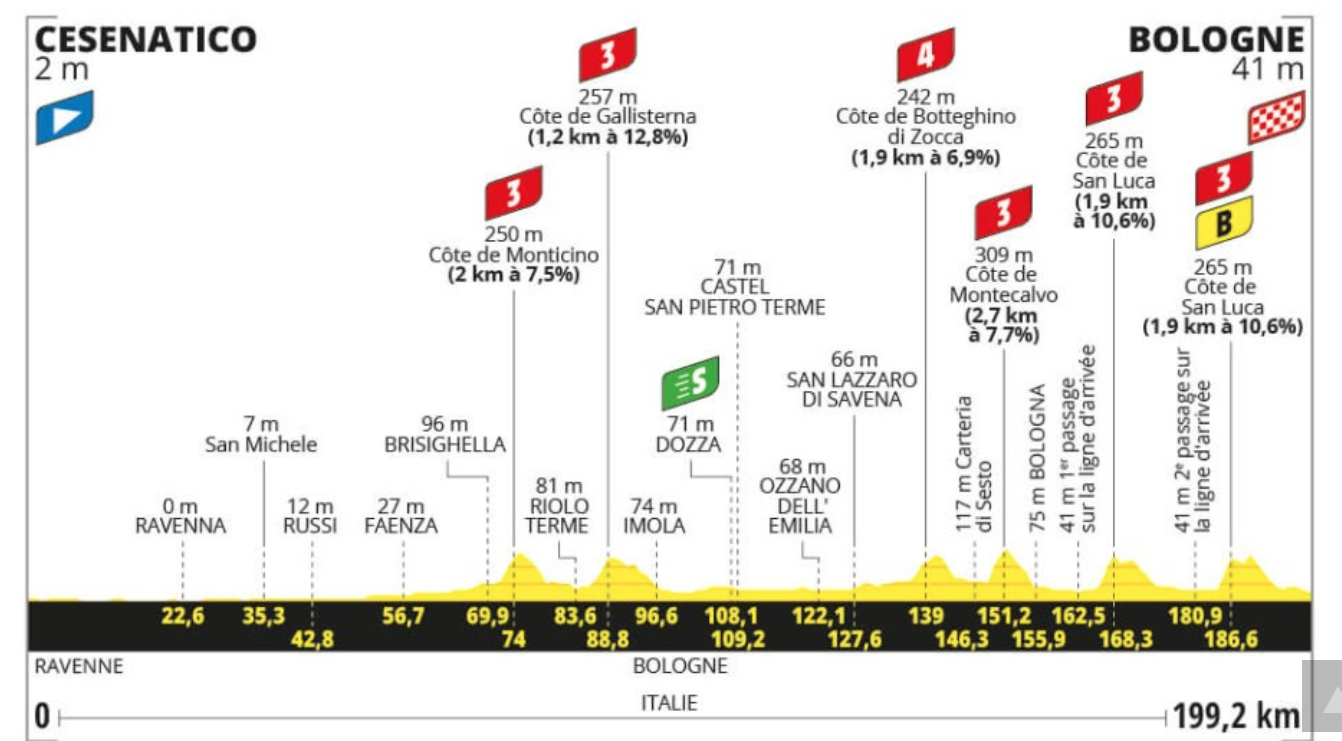
Earlier, we had reviewed the map of stage 2, and googled potential places to stay along the route.
We “scored” by reserving a room at Villa Liverzano near Brisighella. We were delighted to discover that their driveway was right on the tour route.
And, even more delightful were the lovely accommodations, views, and exquisite courtyard dinner. There was one other couple who identified as ‘Tour Groupies’ so over dinner, we strategized where to watch the event the next day.
Day #2
We parked at the base of the villa’s driveway ant took a short walk to the top of the Cote de Monticino.
The Category 3 hilltop finish was festive.
Even the porta-potties had Italian style.
We waited a bit, and then the caravan passed by with the fleet of sponsor cars. A few moments later, J Abrahamsen, the current ‘king of the mountain’”’ crossed the summit in his polka dot jersey.
Soon thereafter, the peloton rode by quickly. We learned that Pogacar would take the yellow jersey that day, and would only relinquish it for one day going forward.
Relaxation in Tuscany
After the frenzy of the tour, we headed back towards Tuscany to visit our friends, Nancy and John in Anghiari, a small village near Arezzo. We enjoyed our two-night stay and delighted in the wonderful local cuisine and relaxed lifestyle. Nancy writes at itch.world on life as an expat.
The view of the walled city from the guest room window was breathtaking.
We visited Anghiari five years earlier and were so happy to return! Actually, this was the impetus of our trip to see the Tour. When Ed read that the Tour would start in Florence, he beamed, “Cool … we can watch the start, and then visit Nancy and John!” This set our trip planning in action.
Visiting A Sacred Site
We visited the Sanctuary of La Verna, a hilltop monastery, made famous by a visit by St Francis of Assisi in 1224. It is a beautiful pilgrimage site located in a National Park. We reverently toured the grounds and admired the views.
So, arrivederci Italia! Our trip was short – only two weeks, but memorable. We are grateful that we could combine the hustle and bustle of the Tour and with “la dolce vita” of Tuscany. Until next time!
In late June, Ed and I spent a delicious week in Puglia – the “heel” of Italy’s “boot”. We rented a car to meander around ancient olive groves and marvel and unobstructed ocean vistas. And, Puglia delighted us with colorful orecchiette pasta, fresh seafood, abundant olive oil, and spectacular gelati.
Gourmet Delights
Orecchiette – literally “small ears” – is a shape of Puglian pasta dating to around 1500. Our orchiette came with a variety of sauces, including a Puglian specialty – Orecchiette con le cime di rapa – handmade orecchiette with turnip tops
Even the most lowly hole-in-the-wall cafe offered the freshest cuisine and homemade flair. We especially enjoyed the mussels and clam linguine in a plaza in Gallipoli.
And an 8-course farm-to-table at Masseria Il Frantoio in Ostuni under twinkling lights was divine. An English-speaking sommelier guided us through the delicious wine pairings.
Not to be outdone, the pasta and calamari at a seaside restaurant in Castrignano del Capo was terrific.
And, the tiramisu topped it all off on many occasions!
Oceans Beckon
Less touristy than its northern neighbors, Puglia is nestled between the Ionian Sea and the Adriatic sea. We were able to swim in both bodies of water on back to back days. The water was warm and the waves were undulating and mild. Nice!
The drive along the Salento peninsula was breathtaking. We drove from Otranto to the most southern tip of Italy – Santa Maria de Leuca. This scenic winding road flirts with the edge of tall limestone cliffs, dropping off into the frothing Adriatic sea and offering some of amazing views. In June, we were early for the throngs of tourists, so traffic was light.
Home of the Trulli
Alberobello, a highly-visited town in Puglia, hosts over 1500 conical structures, known as trulli. Dating from as early as the mid-14th century, they feature conical roofs built over whitewashed mortarless buildings.
The trulli were designed without mortar because they were supposed to be temporary farm shelters. According to experts, “These iconic rural dwellings began appearing as early as the 14th century, and their popularity originated because of a 15th century decree that made urban settlers pay taxes to the crown under feudal rule. If the king’s inspectors came collecting, the villagers could easily demolish these inexpensive buildings into a pile of stones and hide in the forest, and then rebuild them once they’d gone.” We enjoyed walking around the current trulli, and witnessed a local wedding at the only trulli church in the world.
Gourmet Farm Says
Puglia is dotted with masserias — rural farms converted to boutique bed and breakfasts. The masserias are located outside of villages throughout the region. We stayed in two of these – in Ostuni and Otranto, and both were delightful. In Ostuni, we marveled at the orchard with thousand year old olive trees. We learned that Puglia produces 40 percent of Italy’s olive oil.
Charming Villages
Puglia has many small towns nestled among the olive groves. One of our favorites was the hilltop town of Ostuni, known as the “White City”. The whitewashed city beckons visitors from afar.
And the ubiquitous Aperol Spritz is very popular!
Visiting the Cave Dwellings
We spent a magical day and night in Matera – one of the oldest continually occupied settlements in Europe.
Cave dwellers settled here in the Paleolithic Age and residents lived in these caves (in cohabitation with their pigs and goats) up until the late 1950’s. They built an amazingly complex labyrinth of caves on top of each other, nestled along the cliffs.
We visited this cave that had been transformed into a shop.
It was definitely more hospitable than this cave in the early 1900’s, when residents lived in the same cave as their animals.
Today, the caves have morphed into boutique hotels, shops and residences. The town gained popularity when Mel Gibson filmed The Passion of The Christ in 2004, since the ambiance resembles ancient Jerusalem. And, popularity increased when James Bond performed automotive theatrics in Matera’s main plaza in No Time To Die in 2021.
We thoroughly enjoyed our stay in Matera and appreciated the guided tour provided by a local resident. (Matera is technically not in Puglia, but it is in a neighboring state, Basilicata.)
One Minor Wrinkle
During our journey, we had a flat tire in Otranto. Luckily we were near the curb and were able to drive the car to safety. We had noticed a female traffic officer nearby and we showed her google translate’s version of “flat tire” in Italian. She knew just what to do. She called “Bilo” and later told us (in Italian) that he would arrive in treinta minuti (30 min). So, we chilled near the car, and Bilo arrived shortly thereafter.
He put on a spare and we followed him to his shop. The correct tire was not in stock, but we gave him a deposit for a new one and returned the next day, where he put on the tire. The rental company never knew anything about this. And, luckily we were able to tour the countryside using the spare, so our itinerary was not compromised. And, since none of the parties were bilingual (including us), google translate came to the rescue!
Arrivederci Puglia!
Our week in Puglia was relaxing and lovely. We were sorry to leave and hope to return soon to sample even more gourmet delicacies and visit more charming villages. Next time – without a flat tire!
After touring the north of India in April, we proceeded to Pune, a mid-sized city that is home to many software companies, auto manufacturing plants and technology startups. The city was modern and bustling. It’s not really on the typical tourist itinerary, but we visited to work with Ed’s client, Rahul, and his company, Bonzai.
Bonzai’s offices were modern and bright – we could have been anywhere in the world, except for the Indian snacks, Chai, and spoken “Murati” (the local language).
We were able to conduct two morning business sessions for the entire company.
And we spent the afternoons with senior management discussing strategy.
It was a treat to be able to stay with Rahul in his home. We also enjoyed meeting Rahul’s father.
Rahul had been a student of Ed’s in a Stanford Executive Education program. After that class, Rahul asked Ed to consult for his company and they have worked together remotely for the past two years. Rahul visited us in Sun Valley last summer and it was a privilege to visit him in India.
A Visit to Goa
After Pune, we proceeded with Rahul and his wife, Shiny, to Goa, a lively beach town on the coast.
The Portuguese ruled Goa for more than 450 years. This history can be seen in its crumbling forts, baroque architecture, whitewashed churches and cuisine. We learned that the Portuguese left Goa as recently as the 1960s.
We especially liked the Basilica of Bom Jesus, dating from the 16th century.
Sunset on the beach was breathtaking. It seemed like the entire town was outside and enjoying walking along the sand.
In Goa we sampled the local Konki cuisine.
And we enjoyed a nightclub with live entertainment. We selected ‘These Boots are Made for Walkin’ for the singer, and our friends were surprised that we knew all the words!
Goa was relaxing and so much fun! We loved the Portuguese influence and we are so grateful for Rahul and Shiny’s warm hospitality!
Onward to Mumbai
Our final destination was Mumbai, where we stayed in the famous Taj Mahal Palace hotel. (This was the site of the serious bomb attack in 2008.)
The hotel was gorgeous. We enjoyed a tour of the facilities led by a man who had worked there for over 40 years as the personal butler for the CEO of the hotel. He told many colorful stories about famous guests and parties. And, although he was off that day, he knew everyone who was working during the 2008 attack. A memorial fountain pays tribute to those who lost their lives.
But not everything in Mumbai was modern. We also visited the world’s largest outdoor laundry (which uses the same hand washing methodology from ages past.)
And we visited Elephanta Island, with caves from mid-5th to 6th century AD. The stone carvings in the temples in the caves were well preserved and intricate.
We also took a walking tour of the Dharavi slum, which was founded in 1884. Our guide was a resident of the slum, and our tour fees supported education and training for children of the slum.
Photos are not allowed on these tours (to protect the privacy and dignity of the residents), but the tour company provided a link to a few images.
So, thank you India! We had a fabulous month – so much variety and interesting sights to see. We especially enjoyed getting to know the people and culture. Even though there are 1.4 billion people here, we were not overwhelmed by crowds of humanity. Instead, we found peace and quiet and warm hospitality. We’re grateful for the opportunity to visit this fascinating place!